
Product Overview
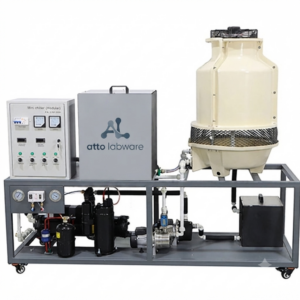
The Mini Chiller Training System with Modular Refrigeration and Thermal Storage is a comprehensive, self-contained pilot-scale thermal engineering plant designed specifically for advanced educational institutions and research laboratories. This training rig gives mechanical, refrigeration, and HVAC engineering students hands-on access to practical energy-shifting technologies and modular refrigeration circuit analysis.
The apparatus effectively simulates standard commercial building peak-load management by utilizing a highly efficient water-chiller circuit combined with modular thermal storage to generate and store thermal energy (as ice) during low-demand periods, subsequently discharging it to satisfy cooling loads without high electrical power drawing.
System Composition & Component Specifications
| No. | Component | Technical Parameters / Specifications | Qty |
| 1 | Condensing Unit | Hermetic/Scroll Compressor assembly operating with eco-friendly R134A refrigerant loop (integrated with a Variable Frequency Drive (VFD) calibrated to convert 60Hz input power frequency to a stable 50Hz operational frequency). Power input: 750W, Nominal refrigerating capacity: 1750W at -15/32°C conditions approx. | 1 Set |
| 2 | Ice Storage Tank | 150L storage volume approx. Heavily insulated double-wall SS304 tank containing high-density polyurethane insulation and dense internal copper heat exchanger coils. | 1 Set |
| 3 | Plate Heat Exchanger | Compact, AISI 316 Stainless Steel brazed plate heat exchanger operating as high-efficiency refrigeration loop evaporator. Cooling capacity approx: 1500 to 2000 W. | 1 pc |
| 4 | Secondary Glycol Tank | 28L fluid capacity approx. Serves as open expansion and mixing tank reservoir for the anti-freeze water-glycol heat transfer charging solution. | 1 pc |
| 5 | Shell & Tube Condenser | Industrial-grade shell and multi-tube water-cooled condenser with copper tube bundle for efficient heat extraction. Cooling capacity approx: 2000 to 2500 W. | 1 pc |
| 6 | Mechanical Cooling Tower | FRP open-type wet cooling tower with integrated axial fan system for condensing-loop heat rejection to ambient environment. Cooling capacity approx: 2000 to 2500 W. | 1 pc |
| 7 | Circulation Pumps | Two high-reliability centrifugal pumps layout: 1x for the Condenser Water loop, 1x for the low-temperature Glycol-Water solution loop. | 2 pcs |
| 8 | Mobile Mounting Rig | Rugged, ergonomic mild steel (MS) square section frame structure, finished with rust-resistant industrial powder coating and 4 locking caster wheels. | 1 pc |
General Technical Parameters
-
Overall Dimensions: 2000 mm (W) × 700 mm (D) × 1850 mm (H)
-
Dry System Weight: Approx. 200 kg
-
Utility Requirements: Single-Phase, AC 230V, 50Hz electrical supply connection (with built-in VFD frequency conversion support)
-
Primary Charge: Refrigerant R134a Gas / Aqueous Glycol Mixing Agent
Analog Instrumentation & Manual Controls
The apparatus features complete manual fluid circuit controls, allowing absolute control over mode changes without software dependency, reinforcing structural mechanical tracking skills:
-
Pressure Indicators: Dial gauges mounted on the refrigeration manifold (Low Pressure: -1 to 9 bar, High Pressure: -1 to 24 bar).
-
Variable Flow Meters: Variable area inline rotameters calibrated for fluid measurement across a range of 8 to 102 L/h.
-
Thermal Measurement Panel: Multi-channel digital temperature scanner connected to local immersion PTD / type-K thermocouples (measuring ranges from -20°C to 60°C) across all heat-exchanger terminals.
-
Flow Control Manifold: Industrial-grade brass 3-way manual valves and isolating ball valves strategically placed to switch loop configurations.
Laboratory Experiments & Exercises
-
Introduction to Modular Refrigeration & Thermal Storage: Visualizing the mechanics of commercial chilled water plants and peak-load shifting strategies.
-
Fluid Loop Routing & Balancing: Tracing and calculating flow behaviors inside the R134a loop, secondary glycol loop, and open cooling water loop.
-
Ice Production Operation (Charging Mode): Measuring charging time, refrigeration plant input, and temperature drop profile during ice buildup via VFD-assisted power regulation.
-
Cooling Load Delivery Operation (Discharging Mode): Deactivating the core refrigeration plant and running purely off ice-melting thermal power delivery.
-
Thermodynamic Performance Evaluation: Manually logging data points to calculate the system Coefficient of Performance (COP) and creating complete heat energy balances.