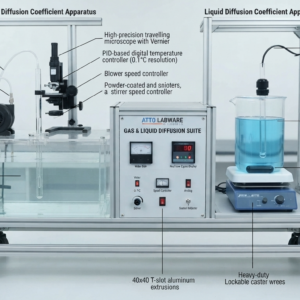

Gas and Liquid Diffusion Coefficient Apparatus
The Atto Labware Diffusion Suite provides a comprehensive platform for the fundamental study of mass transfer. Our apparatuses are designed to satisfy modern engineering laboratory requirements, facilitating the verification of Fick’s Law through both gaseous and liquid phase experiments. By utilizing a modular frame constructed from 40×40 T-slot aluminum extrusions, these units ensure long-term durability and structural rigidity, maintaining a professional aesthetic consistent with the Atto Labware India standard.
1. Gas Diffusion Coefficient Apparatus (Stefan Diffusion)
This apparatus enables the accurate determination of the diffusion coefficient of a volatile liquid evaporating into a stagnant air layer.
Technical Working Principle
The unit operates on the principle of steady-state molecular diffusion. A volatile liquid, such as acetone, is contained within a precision-bored vertical glass capillary tube. This tube is submerged within a thermostated water bath to maintain a constant vapor pressure environment. As the liquid evaporates, the vapor diffuses through the stagnant air column and is removed at the top by a controlled air stream. The diffusion coefficient is calculated by monitoring the downward recession of the liquid meniscus over a measured time interval.
Key Features & Components
-
Precision Thermostated Bath: Constructed from high-grade acrylic or stainless steel, ensuring uniform temperature distribution around the capillary cell.
-
Glass Capillary Assembly: Custom-blown borosilicate glass capillary tubes, ensuring chemical resistance and thermal stability during high-temperature testing.
-
Airflow Regulation: An integrated centrifugal blower system, complete with a flow-control needle valve to ensure a stagnant air layer is maintained within the capillary.
-
Measurement Instrumentation: A high-precision travelling microscope with a Vernier scale (0.01 mm resolution) is mounted on a dedicated rail for accurate meniscus level monitoring.
-
Digital Control Panel: A user-friendly, powder-coated aluminum panel houses the digital temperature controller (PID-based) and the blower speed controller.
2. Liquid Diffusion Coefficient Apparatus
Designed for the study of mass transfer in the liquid phase, this apparatus focuses on the diffusion of a solute through a stagnant solvent.
Technical Working Principle
This system measures the molecular diffusivity between two liquid phases of differing concentrations. To eliminate the influence of natural convection, the apparatus employs a “diffusion cell” containing an array of capillaries or a honeycomb structure. A concentrated solute is placed in the top chamber, and its diffusion into the solvent below is monitored. This process allows students to observe the unsteady-state diffusion process and calculate the diffusion coefficient based on the concentration change over time.
Key Features & Components
-
Diffusion Vessel: A clear, 1.0-liter borosilicate glass or acrylic tank, allowing for visual observation of the diffusion process.
-
Honeycomb Diffusion Cell: A specialized capillary array that permits only unidirectional molecular movement, ensuring experiments strictly follow Fick’s Law.
-
Stirring System: An integrated magnetic stirrer motor with an adjustable speed control to ensure the bulk solution remains homogeneous, maintaining “sink conditions” throughout the experiment.
-
Conductivity Monitoring: A high-sensitivity digital conductivity meter provides real-time data on the solute concentration increase, which is essential for accurate coefficient determination.
-
Experimental Accessories: Each unit includes a digital stopwatch, specialized cleaning brushes for the capillary cells, and calibrated solute samples.
Manufacturing Excellence by Atto Labware
At Atto Labware, we prioritize technical precision and operational safety. All electrical components, including heating elements and controllers, are shielded to meet rigorous safety standards. Our modular design allows for rapid maintenance and assembly, which is critical for high-use educational environments.
| Specification | Details |
| Material Construction | 40×40 T-Slot Aluminum, Borosilicate Glass 3.3 |
| Temperature Control | PID Controller (0.1°C resolution) |
| Data Measuring | Analog Indicators or Optional Digital/RS232 Interface for PC logging |
| Mobility | Heavy-duty lockable caster wheels |
Subject to the specifications will change.