| Component |
Specification |
| System Type |
Two-Shaft Gas Turbine (Gas Generator + Power Turbine)
Air Supply: Laboratory-grade compressed air source |
| Core Modules |
High-performance industrial-grade turbocharger assemblies |
| Generator |
Permanent Magnet Alternator (PMA) with optimized 500w output |
| Frame Material |
Industrial-grade, powder-coated MS/Aluminum profile |
| Safety Shielding |
Transparent, high-impact polycarbonate safety enclosure |
| Control Logic |
PLC-based automated start-up/shutdown safety sequence |
| Instrumentation |
Multi point temperature thermocouples and digital pressure transducers |
4. SAFETY & CONTROL SYSTEMS
Safety is the priority for the Atto Labware design philosophy. The trainer includes:
-
Emergency Shutdown: Automated solenoid-operated fuel shut-off valve linked to an E-Stop circuit.
-
Lubrication Management: Pressurized oil circulation system with integrated safety switches to prevent bearing failure.
5. REQUIRED UTILITIES
-
Electrical Supply: 220/380V, 50-60 Hz three-phase power for control systems and instrumentation.
-
Fuel Supply: Regulated Propane/Butane gas supply.
6. ATTO LABWARE ADVANTAGE
-
Educational Documentation: Every unit is supplied with detailed manuals covering installation, utilization procedures, and experimental exercises with sample results.
-
Modular Design: Optimized for ease of operation and maintenance in a laboratory footprint.
-
Precision Engineering: Built with rugged industrial components to ensure long operational life and reliable performance.
Working Principle: Two-Shaft Gas Turbine Laboratory Trainer
Manufacturer: Atto Labware India
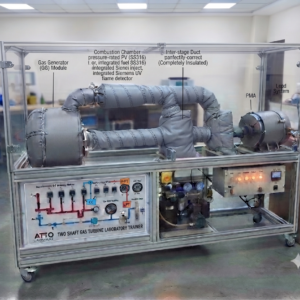
The Atto Labware Two-Shaft Gas Turbine Trainer operates on the fundamental Brayton Cycle, providing a sophisticated platform for demonstrating the conversion of chemical energy into mechanical and electrical power. The system is uniquely engineered with a decoupled two-shaft architecture, separating the Gas Generator (GG) core from the Free Power Turbine (PT) to mirror industrial power generation standards.
The operation begins with an industrial-grade air blower providing a high-volume, controlled air stream to the compressor inlet of the gas generator. This air is compressed and directed into a specialized high-temperature combustion chamber, where fuel—such as propane or kerosene—is injected and ignited. The resulting high-energy, high-pressure gas expands through the first turbine stage, which serves solely to drive the compressor, maintaining the “gas generator” core in a self-sustaining cycle.
Crucially, the hot exhaust gases from the gas generator are then channeled through an insulated inter-stage transition duct toward the second-stage Free Power Turbine (PT). Unlike the gas generator, the PT is not mechanically linked to the compressor; instead, it extracts the remaining kinetic energy from the gas flow to rotate an output shaft. This mechanical rotation is transmitted via a high-precision synchronous toothed timing belt to a Permanent Magnet Alternator (PMA), which converts the shaft energy into electrical output.
The Atto Labware system integrates a PLC-based control logic that monitors the entire sequence, ensuring the system remains within safe operating parameters. Real-time performance metrics—including stage-by-stage pressure, temperature, and RPM—are captured by an integrated Data Acquisition (DAQ) system, allowing students to map the Brayton cycle, determine thermal efficiency, and analyze load characteristics. This trainer represents the pinnacle of educational engineering, combining robust mechanical fabrication with precise digital instrumentation to facilitate an immersive learning experience in thermodynamics.